martes, 24 de diciembre de 2013

Wintering waterfowl

 Common Coot (Fulica atra), Tufted Duck (Aythya fuligula) and Pintail (Anas acuta)

Above is a shot of the main irrigation pond in Las Martelas, where, on December 20, there were 4 Coots (Fulica atra), one Tufted Duck (Aythya fuligula) and one Pintail drake (Anas acuta) - interestingly, not the same eclipse male shown in a recent post (see 16/11/2013). Hardly an overwhelming abundance of waterbirds, but fairly typical of La Palma's winter season.

 Pintail drake (Anas acuta) with Tufted Duck (Aythya fuligula)

In another one of the ponds there are 43 wintering Coots, but so far, I have only discovered 4 Teal (Anas crecca). In a good year, the total can reach the thirty mark. Below, a couple more pictures of the handsome male Pintail:


Elsewhere on the island, the pale morph Booted Eagle (Hieraaetus pennatus)  has been seen regularly over the last few days on the east side, and a pair of Barbary Falcon (Falco pelegrinoides) have begun their mid-air courtship displays.

A trip to the saltpans in Fuencaliente  is pending, and also a check on the Semipalmated Plover (Charadrius semipalmatus) at the airport pools. Stay tuned.


domingo, 15 de diciembre de 2013

Booted Eagles

 Booted Eagle (Hieraaetus pennatus) dark morph: photo Antonio Camacho Lorenzo

The Booted Eagle (Hieraaetus pennatus) is a regular but scarce passage migrant in winter on the Canary Islands. On La Palma, solitary birds are reported almost every year, with as many as five individuals on the island simultaneously in 2007. Not much larger than the resident Common Buzzard (Buteo buteo), and often flying at considerable altitudes, their presence is easily ignored.

 The same bird, being harassed by a kestrel. Photo: Antonio Camacho Lorenzo

The first two photographs in the present post were kindly sent to me by Antonio Camacho Lorenzo, who observed this dark morph bird in Los Barros (Los Llanos de Aridane) on Dec 14.

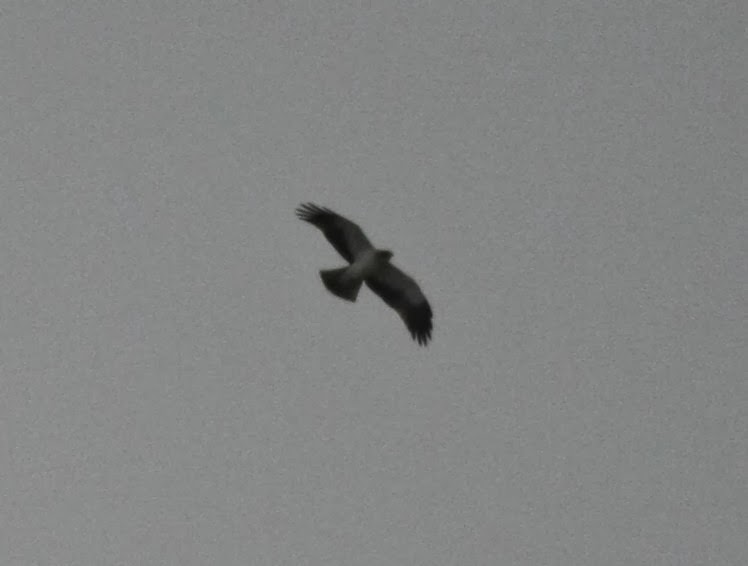
However, the first notification of Booted Eagle received this year came from a visiting birder (John Perry) who saw a pale morph specimen above the Parador in Breña Baja on Oct 24. I made a couple of unsuccessful attempts to find his bird, but it wasn't until Dec 13 that I spotted a pale morph eagle soaring above the Risco de la Concepción viewpoint near Santa Cruz: possibly the bird observed by John Perry? As usual, the migrant raptor was being persistently harassed by kestrels and a small flock of Red-billed Chough.

Returning to the viewpoint today (Dec 15), I had distant views of the same pale morph bird, and managed to get the two pictures below...proof that there are at least two Booted Eagles on the island at the moment.

 Booted Eagle (Hieraaetus pennatus), pale morph


viernes, 6 de diciembre de 2013

Semipalmated Plover IV

Semipalmated Plover (Charadrius semipalmatus)

The present post is an update on the Semipalmated Plover (Charadrius semipalmatus), which has appeared a number of times in this blog to date. This extremely rare Transatlantic migrant - only the fifth sighting of the species for Spain - was first discovered at the beginning of October by two visiting birders, and has subsequently been seen by several other observers at the same location.

I have been checking the airport pools at regular intervals in recent weeks, to see if the bird is still there, and this morning I had no intention of photographing it. However, conditions were favourable, there were initially no disturbances, and my subject was in a convenient spot. In the shot above, it can be seen resting amid chunks of broken lava.

Unfortunately, its rest period was destined to be brief...


Shortly after the bird had settled down, a noisy family arrived on the scene with two dogs, one of which came sniffing towards the plover, followed by its owner. The bird logically took flight, together with its companions, three Ringed Plover (C. hiaticula).

It is surprising that this migrant has remained for so long in what is an extremely popular, totally unprotected area.

There are also several other waders present at the pools:

3 x Bar-tailed Godwit (Limosa lapponica), 1 x Grey Plover (Pluvialis squatarola), 1 x Dunlin (Calidris alpina), 1 x Whimbrel (Numenius phaeopus), and, unusually, 1 x Ruff (Philomachus pugnax).

At the saltpans in Fuencaliente this morning, I only found 2 x Dunlin (Calidris alpina) and 3 x Sanderling (Calidris alba)

sábado, 16 de noviembre de 2013

Northern Pintail


Northern Pintail (Anas acuta

Not exactly the first migratory duck detected on the island this autumn - I spotted a juvenile/female Eurasian Teal (Anas crecca) a few days ago - but this Northern Pintail (Anas acuta) could be described as the  first interesting one. The photo above was one of the last to be taken  this morning, but shows the subtle plumage hues better than the earlier shots below. Notice the very blotchy neck and two-tone bill.


The dark speculum was momentarily visible as the bird landed - bordered white at rear and rufous at front - indicating an eclipse male.


Above: male eclipse Northern Pintail (Anas acuta) showing speculum borders


Apart from this elegant "greyhound among ducks" (Collins Birdguide), the following migrants have also been seen at various ponds in Las Martelas recently:

1 x Northern Lapwing (Vanellus vanellus)
2 x White Wagtail (Motacilla alba)
1 x Eurasian Teal (Anas crecca)

There are also aproximately 40 Eurasian Coot (Fulica atra) in the same area, and the usual small numbers of Greenshank (Tringa nebularia), Green Sandpiper (Tringa ochropus), Common Sandpiper (Actitis hypoleucos) and Snipe (Gallinago gallinago).

The big birding news throughout Spain at the moment is the recent sighting of a Wilson's Snipe (Gallinago delicata) on Tenerife (see http://avescanarias.blogspot.com). This will be the first for Spain if accepted by the Spanish Rarities Committee.

The Semipalmated Plover (Charadrius semipalmatus) was still present at the airport pools on La Palma on Nov 17. Check the previous post in this blog for updates, or visit http://www.reservoirbirds.com

jueves, 31 de octubre de 2013

Semipalmated Plover: the story so far...

Followers of this blog will be familiar with the Semipalmated Plover (Charadrius semipalmatus) which has now been at the airport pools on La Palma for about one month. Just to recap, here is a brief summary of the story so far...

Oct 4: The bird was discovered and correctly identified by Tom Brereton and Marcus John, about 45 minutes before they were due to catch their flight back to the UK. They observed the bird through a telescope, but failed to get satisfactory photographs. That evening, I received the following, extremely concise email from Tom: "Semipalmated Plover airport pools".

Oct 5: Not entirely convinced that the alert wasn't some kind of practical joke, I headed for the site with my photographic gear, and within minutes of arrival had found the mega-rarity. The first photos were posted on my website the same day.

Oct 8: I returned to the airport pools and posted another set of pictures on "La Palma Birds", including a couple of views of the not very scenic location and surroundings.

Oct 18: The bird was observed at the same spot by a visiting birder, Javier Orrit (pers. com.)

Oct 19: An early visit with good light conditions and absence of disturbances produced my best pictures of the bird so far. The various differences between semipalmatus and hiaticula were now evident, thanks to the convenient proximity of the latter.

Oct 23: Javier Orrit and myself observed the bird with a telescope.

Oct 27: I checked to confirm that the bird was still present.

Oct 29:  Another visiting birder, John Perry, informed me of his personal sighting.

Oct 31: Together with two visitng birders, Juan Sagardía and José Portillo, the bird was observed again. Juan also filmed, recorded, and photographed it. (José Portillo is presently the presumed leader of the Spanish version of "The Big Year" - an unofficial twitching race to see the largest number of bird species in 2013 within Spain, including the Canaries, Balearics, Ceuta and Melilla. With the total number of Spanish species standing at 569, and another two months to go, José Portillo is already nearing the 400-mark. The Semipalmated Plover at the airport pools on La Palma has been another valuable addition to his list. More details of the competition and an interview with José Portillo at http://rbsbt.blogspot.com.es/2013/07/el-gran-ano-2013-medio-camino.html in Spanish).

The bird confidently associates with a small flock of Ringed Plover, a species which regularly winters on La Palma...so there is a very good chance that the semipalmatus will stay with them.

Nov 9: 14h The bird was still present at the airport pools.

Nov 10: Observed by a visiting birder,  Óscar Llama (pers. com.).

Nov 15: The bird was still present at the same site.

Nov 19: It was seen by Clemente Usategui at the same location (pers. com).

Nov 22: I observed the bird at the same spot.

Nov 24 & 25: Still present (Sergi Fernández)

Nov 27: Still present at same site.

sábado, 19 de octubre de 2013

Semipalmated Plover III

 Semipalmated Plover (Charadrius semipalmatus)

The Semipalmated Plover (Charadrius semipalmatus), featured in the previous post, was observed yesterday Oct 18 at the same location by Javier Orrit, so I returned to the site this morning to take a few more photographs of the bird.


The close proximity of 3-4 Ringed Plover (C. hiaticula) for comparison facilitates appreciation of the differences between the two species. C. palmatus has paler, thinner legs, a shorter, more conical bill, an overall "daintier" build, and a thin orbital ring absent in hiaticula.


This morning I was less concerned with photographing the bird's feet, since my earlier photos show the webbed toes well, but above is another clear view of the webbing between the two inner toes.


When not foraging at the edges of the tidal pools, this Semipalmated Plover conceals itself amongst stones in the gravelly areas nearby, together with small groups of Ringed Plover.


A number of the previously-mentioned differences between semipalmatus and hiaticula can be seen in the picture below:

Charadrius semipalmatus and C. hiaticula

martes, 8 de octubre de 2013

Semipalmated Plover II

 The "airport pools" looking north, with the airport access road visible on the left, and  Santa Cruz de La Palma in the distance.

 The "pools", locally known as Las Maretas, are actually disused gravel pits which provided materials for the construction of the airport. 

Despite the unpicturesque surroundings, the location is very popular with all kinds of people, especially at weekends and on sunny afternoons: dog-walkers, joggers, bait-gatherers and anglers, families with young children, and cars and even caravans can all be found here. How the Semipalmated Plover (Charadrius semipalmatus) will cope with all this potential disturbance remains to be seen, but the bird was still foraging at the site this morning (Oct 8), together with two or three Ringed Plover (C. hiaticula).


Note the difference in size between Semipalmated (foreground) and Common Ringed in the above image. The obvious webbing between the two inner toes, a diagnostic identification feature of semipalmatus, can also be appreciated.

The bird was in a less-favourable spot for photography this morning, so I have been unable to improve on the first photos taken on Oct 5. The verdict of several experienced observers coincide in that this specimen is not a juvenile, as previously assumed,  but an adult.

This record of Charadrius semipalmatus, if accepted by the Spanish Rarities Committee, will be the fifth for Spain, and the first for the Canary Islands. It seems likely that such low numbers of sightings do not reflect the real numbers of semipalmatus arriving in the country, but can be attributed to the fact that this species is very easily overlooked.